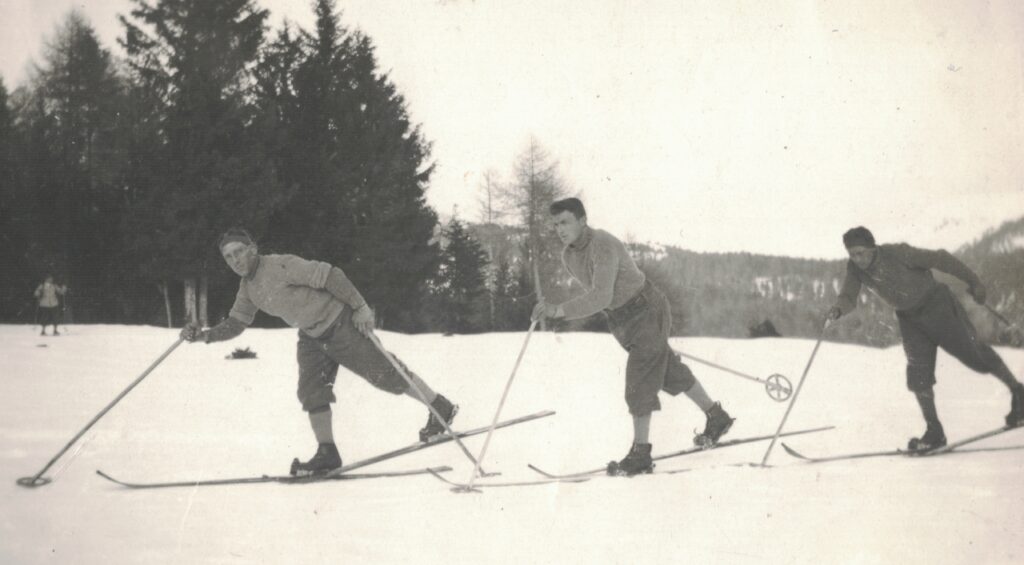
SKI AND MOUNTAIN EQUIPMENT
For a long time, skiing lacked specific footwear: until the end of the 19th century, skiers wore leather work boots, attached to the skis with laces. In the early decades of the 20th century, the Telemark style emerged, characterised by a free heel and bindings that locked only the toe of the boot. Boot specialisation began in the second half of the 1930s with the Kandahar bindings, which led to the introduction of reinforced Vibram soles, laces, and additional laces for greater stability.
In the 1950s, with the spread of skiing as a sport, equipment evolved rapidly: separate models for men and women appeared, soles became smooth, and internal bindings were introduced to improve grip. In the 1960s, the first plastic outer shells appeared, laces were replaced by hooks, and, in the following years, boots became progressively stiffer and more high-performance, ultimately having plastic shells and inner linesr in the 1980s. Clothing is also evolving at the same time: from wool to lighter and more durable synthetic fibers, to technical materials that improve comfort, safety, and performance.
Snowshoes are a very ancient tool designed for walking on snow without sinking. Already popular in the Middle Ages and made with wooden frames and woven ropes, they were used for a long time in both civilian and military settings. Since the 1990s, they have become increasingly popular thanks to modern materials and the growth of more sustainable tourism and sports practices.