WORK IN THE FIELDS

Until the second half of the twentieth century, when the spread of winter sports tourism brought new prosperity, life in the Alpine valleys was characterised by a rural subsistence economy. Field work in Valtellina was marked by harsh and continuous daily toil, made even more demanding by the mountain environment. Every patch of land was precious and had to be exploited to the fullest, following rigorous crop rotation cycles and entirely manual soil preparation. In this subsistence economy, women’s role was essential: in addition to domestic chores, they mowed the meadows, hoed the land, and carried wood and hay in panniers almost as heavy as mules’ loads. In remote geographical settings, often isolated for long periods, their constant contribution was essential to the family’s sustenance.
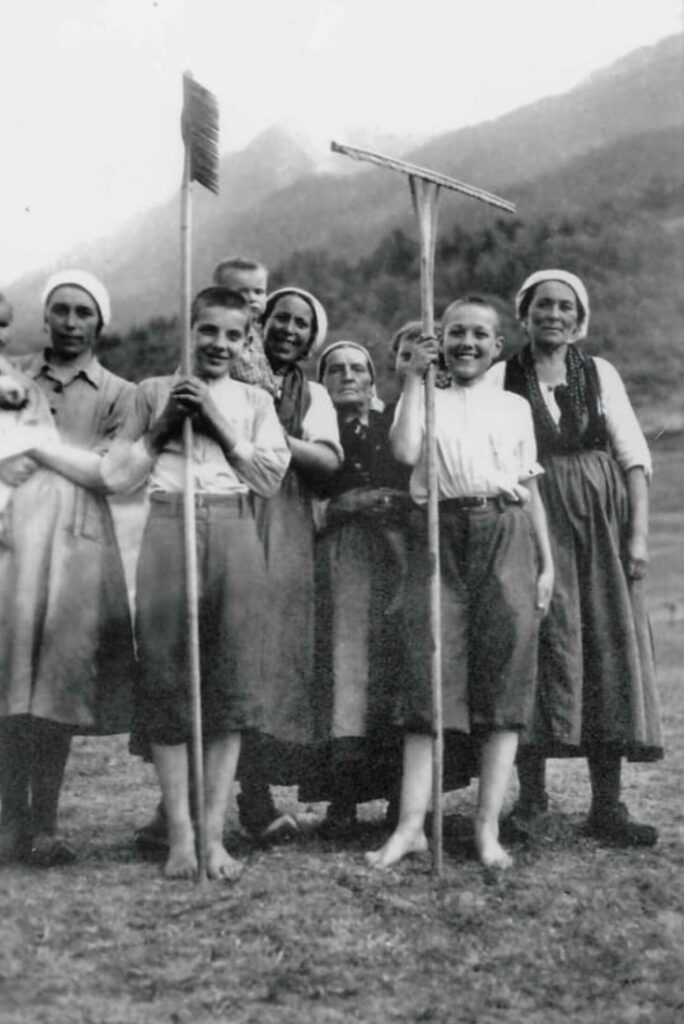
A group of women and children pose smiling while taking a break from working in the fields, Grosio, 1940. Martino Strambini and Maria Cecini Archive, Villa Visconti Venosta Photographic Collection. "We Are the Alps" project, Cultural Archives of Valtellina and Valchiavenna
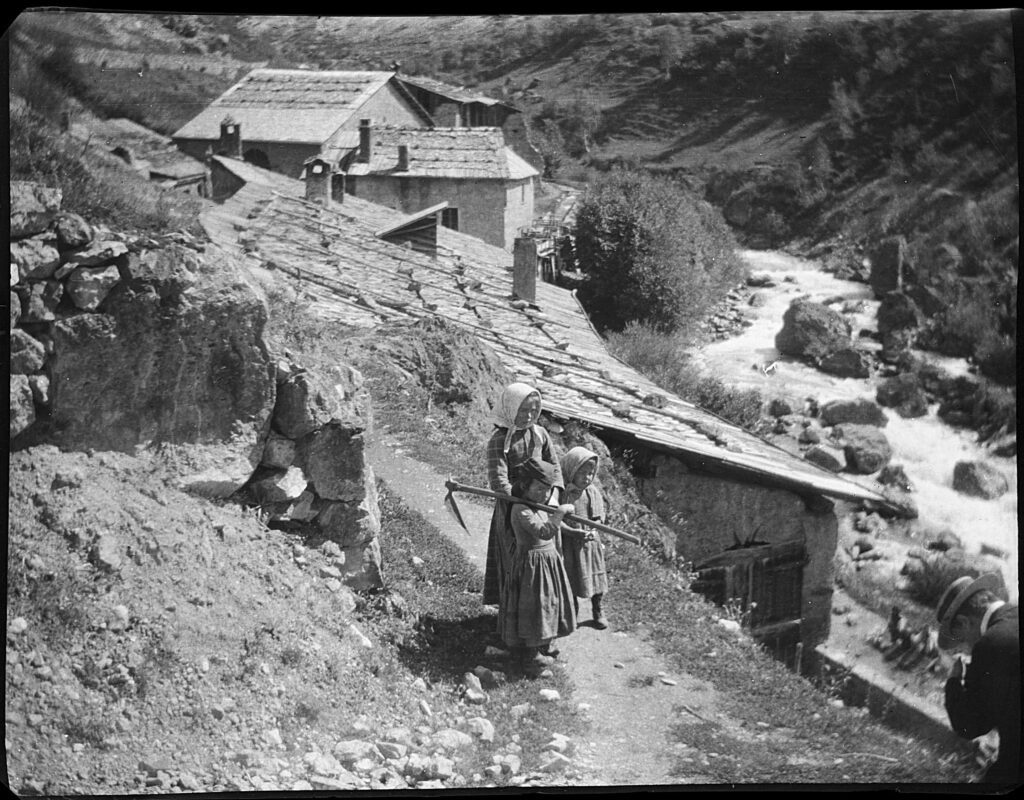
Peasant girls returning from the fields, Premadio, 1894. Alta Valtellina Historical Studies Center (A.L.), Castello d'Albertis Archive, Museum of World Cultures, courtesy of CSSAV

Objects

  1. Plow (Aradèl) The plow, pulled by humans or animals, was used to turn clods of earth and create furrows in the soil, thus preparing it for sowing.
  2. Hoe – Where the soil was harder or roots needed to be cut, a hoe was used. About halfway along the wooden handle, a protrusion allowed the knee to rest on it, allowing the shovel-shaped blade to press down on the hay.
  3. Flail (Fièl) The flail was used to beat grains during hand threshing. It was composed of two sticks of different lengths: one longer served as a handle (manabrìl), while the other, connected to the first with a leather strap (corigin), was stockier and heavier and was used to beat the grains (vèrga).
  4. Hammer (Martéi de pra) A hammer used to sharpen the sickle for haymaking.
  5. Hay spade (Vanga del fé) A tool used for cutting hay in the barn.
  6. Gerlo (Gérlu) A typically Alpine transport tool, the gerlo (gérlu) is a large basket shaped like an inverted cone with two straps for carrying on the back. It was made by tightly weaving strips of hazelnut branches (scudesce) over a frame of chestnut branches. Very capacious, it could support considerable weights and was therefore popular for transporting grapes, manure, leaves, and potatoes. Another typical use: to carry up the soil that had collected at the bottom of the slope in sloping fields.
  7. Hay basket (Campàcc) For transporting hay and dry foliage, a loosely woven container, called a “campàcc,” was also used, lighter and more capacious than the tightly woven one. Made of birch branches, very narrow at the base and wide at the opening, it was reinforced at the top and middle with thick cords. The shoulder straps (umbrai) were made of willow wood.
  8. Sedan Chair (Purtantìna) It was secured to the back with willow straps and used primarily to carry butter and cheese from the mountain pastures down to the valley.