SPINNING AND WEAVING

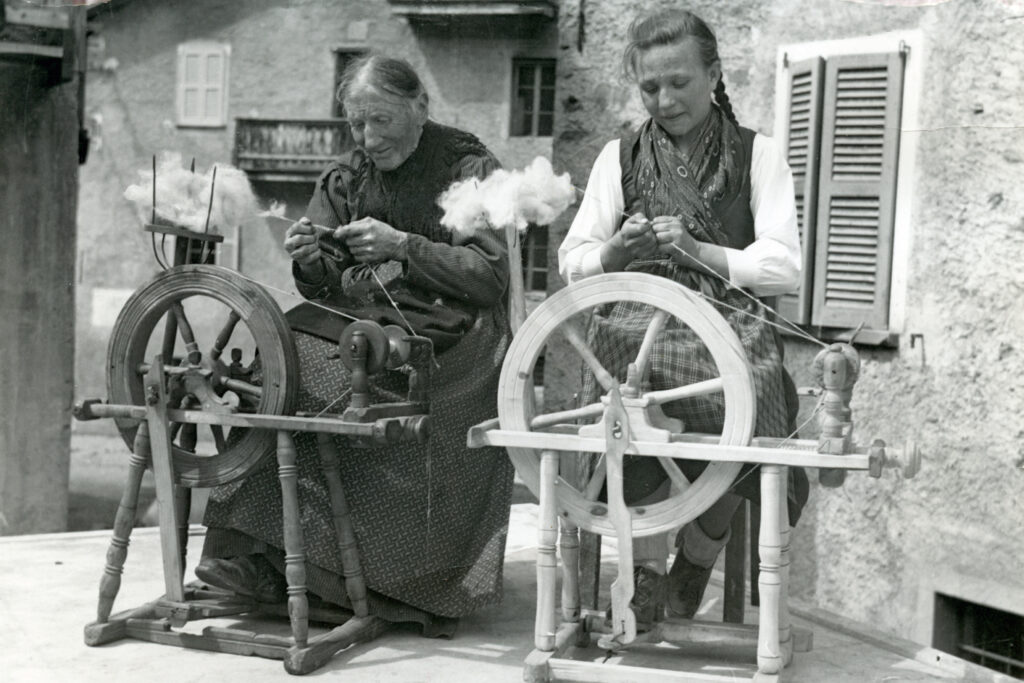
For centuries, spinning, weaving, and carding were central activities in the lives of women in Valtellina. After shearing, the wool was processed by women. It was often gathered outside their homes: the fleece was cleaned of impurities and untangled using carders (scartàsc), wooden boards with handles and metal tips, which were rubbed against each other to “comb” the fibers and prepare them for spinning. During the long winter months, coarse wool was spun and woven for socks and sweaters, as well as blankets, rugs, and other household necessities.

Alongside wool, plant fibers, especially hemp and flax, played a central role. Their processing required long and complex preparation: after maceration and drying, the stalks were frayed with a scutcher , a tool that broke the woody part, releasing the fibers. Hemp, grown both in the plains and mountains, was primarily used for the domestic production of sheets and towels.
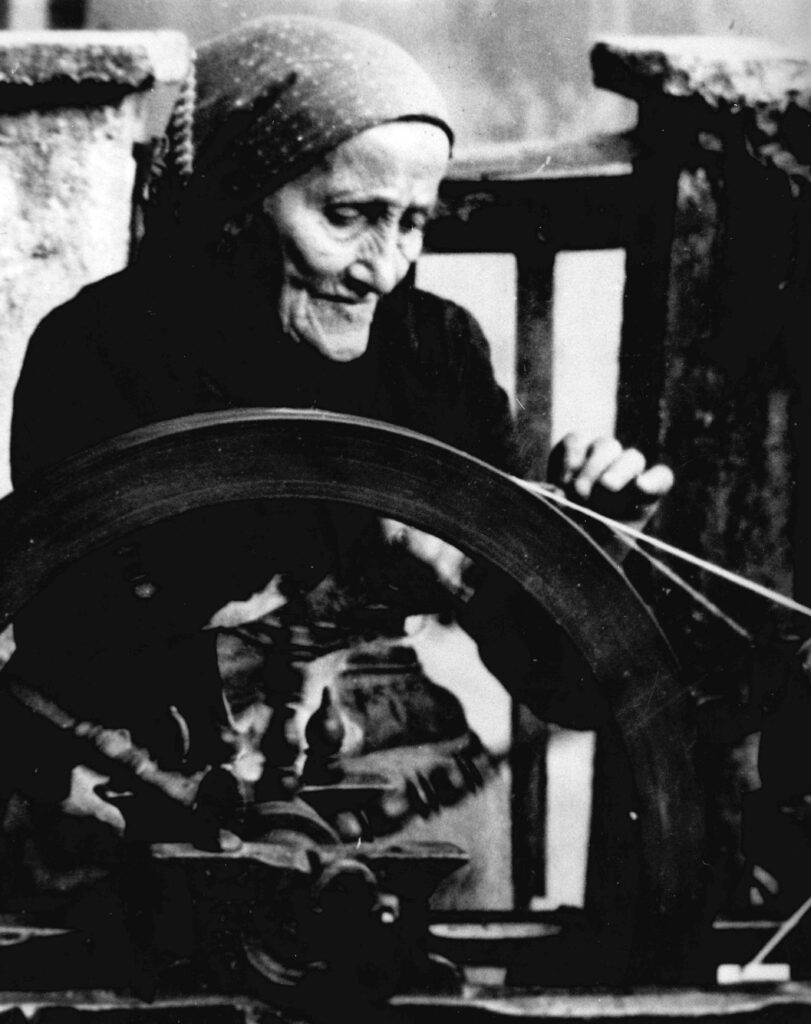
A woman spinning wool using a spinning wheel (carèl), Chiesa in Valmalenco, 1960. Archive and photographic collection of the Chiesa in Valmalenco Municipal Library. "We Are the Alps" Project, Cultural Archive of Valtellina and Valchiavenna
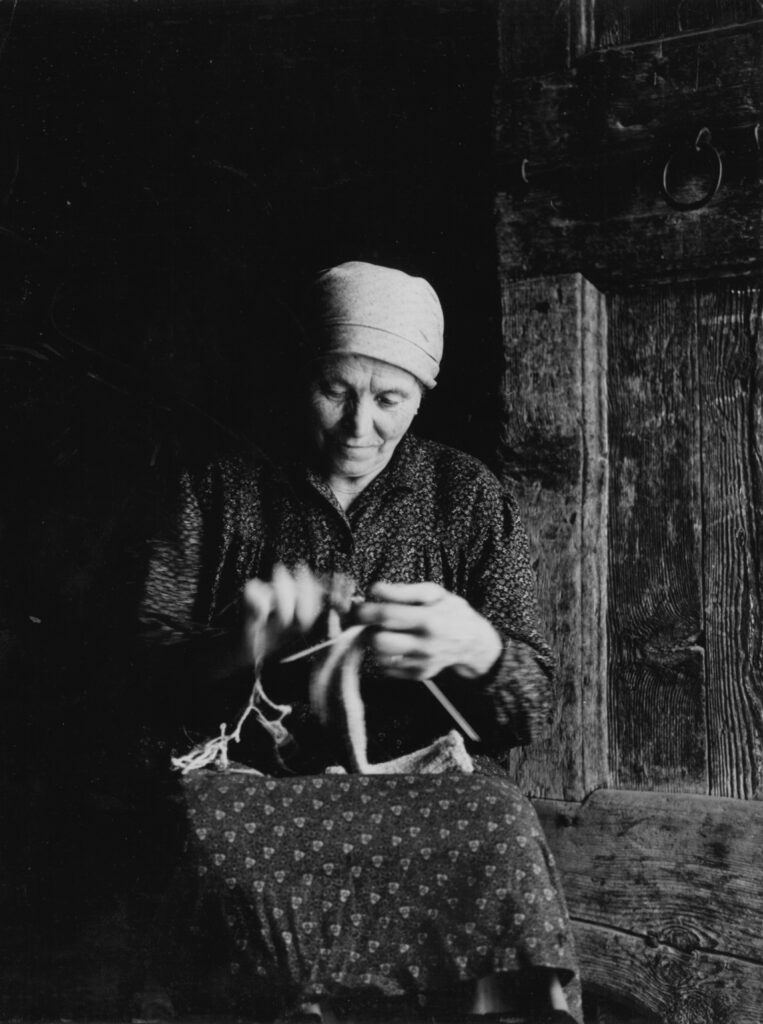
A woman knitting in front of her home, Sondalo, 1960. Photograph by Stefano Ferragni, Annalisa Graneroli Archive, Sondalo Sanatorium Museum Photographic Collection. "We Are the Alps" Project, Cultural Archive of Valtellina and Valchiavenna
Two women spinning wool in Sant'Antonio Valfurva, 1942, photographic collection of the "Mario Testorelli" Valfurva Valley Museum. "We Are the Alps" Project, Cultural Archive of Valtellina and Valchiavenna

Objects

  1. Wool Brush (Scartàsc)
    They were used in pairs. The textile fibers were combed to align the fibers and remove impurities.
  2. Reel (Asp) A rotating tool used during wool processing to wind the yarn into a skein. A similar tool was used for the reverse operation, from the skein to the ball.
  3. Hemp and Flax Scutcher (Gràmula del cànef) The flax and hemp stalks were beaten with the kneader to separate the fibrous part from the stem: operated with a handle, the three long spatulas, arranged in series and secured with a device at one end, broke the woody part of the stems.
  4. Scutching knife (Spàdula) This wooden tool, sharpened on both sides, was used to remove impurities from hemp and flax fibers.
  5. Hemp and Flax Cardo (Spinàsc) A tool used in processing hemp and flax already treated with the scutcher and scutching knife. The fibers, combed and aligned, are ready for spinning.
  6. Spinning Wheel (Carèl) A pedal-operated machine used to spin textile fibers by pulling, twisting, and winding the thread, which was then coupled and twisted by hand with the spindle.
  7. Pelórscia A coarse and sturdy hemp fabric, it served many purposes in rural life: it was placed on haystacks to protect them from the rain, it was placed on the back of a sick cow, it was spread on the ground in the field to thresh buckwheat, and it was used as a sheet or blanket in the humble bedding of mountain huts