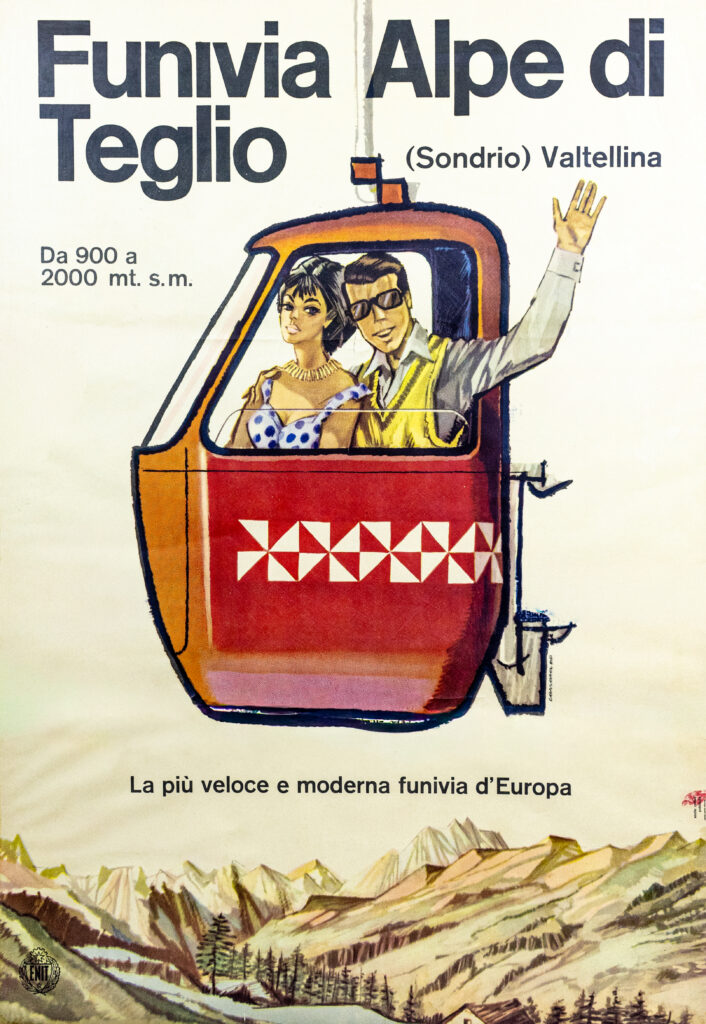
The tourism evolution of Teglio and the nearby Prato Valentino ski area tells a story shared by many mid-mountain areas. As the ancient capital of Valtellina, Teglio has been a tourist destination since the early 20th century, appreciated for its healthy air and sunny exposure, ideal for treating lung diseases. The first hotels open – the Combolo in 1905 and the Albergo Teglio in 1927 – and connections with local aristocratic families attract a wealthy clientele.
In 1961, the inauguration of the Teglio-Prato Valentino cable car, considered the most modern in Europe, marks the beginning of ski tourism. Chairlifts and ski lifts allow access to altitudes of up to 2,600 meters, but southern exposure and lack of artificial snowmaking limits the development of the ski area. The cable car stays in service until the 1980s, when it is dismantled and replaced by a road link. After years of intermittent operation, the station closes in 2002.
Prato Valentino reopened in 2012, but weather conditions did not guarantee a stable season. In 2025, with the facilities reaching the end of their lifespan and attempts at entrepreneurial revitalization having failed, the Prato Valentino 2050 project, promoted by the Mountain University, was launched. The goal is to rethink tourism in a participatory, sustainable, and seasonally appropriate way, involving local communities, tourists, and second-home owners to build a new vision of shared mountain development.